


A New Zealand branch office is an extension of a foreign company in this country, which means it is legally bound to complete the activities of the parent company. Those who want to open a branch office in 2024 can rely on our New Zealand company formation consultants for assistance in registering this business form.
Just like foreign investors, foreign companies interested in setting up their business presence in New Zealand benefit from very advantageous conditions. Among these, the possibility of deciding the type of structure they can use for their operations in New Zealand. Foreign companies can open subsidiary companies or branch offices in New Zealand.
Our team can help you open a company in New Zealand irrespective of the chosen business form. With our help, handling all or part of the incorporation steps will be easier. An appointed representative from our team will be able to help you with ongoing assistance throughout incorporation, and act on your behalf when you are unable to be present in the country.
| Quick Facts | |
|---|---|
| Applicable legislation |
The New Zealand operations are governed by New Zealand laws. |
|
Best used for |
– banks, – financial institutions, – other types of businesses |
|
Minimum share capital |
No |
| Time frame for the incorporation (approx.) |
4 days, depending on name availability and the provision of all of the documents needed for the application |
| Management |
Foreign |
| Legal representative required |
Yes |
| Local bank account |
Yes |
| Independence from the parent company | No |
| Liability of the parent company | Full liability |
| Corporate tax rate | 28% |
| Possibility of hiring local staff | Yes |
Table of Contents
Requirements for opening a New Zealand branch office in 2024
Foreign companies seeking to set up branches in New Zealand are subject to the requirements imposed by the Company Law which provides for the following:
- the branch office must have a legal address and a resident representative;
- the branch office must have a local management body, which can be made of natural persons or other companies;
- the parent company is required to file the necessary documents for incorporation with the Companies Register in New Zealand;
- the representative of the parent company must open a corporate bank account with a local bank.
The Overseas register is the one used in the case of overseas companies set up as a New Zealand business. Advanced searches on existing companies are possible, however, those interested should note that not all information about an overseas company is kept by the Overseas Register. Details about the shareholdings or liquidation-related issues must be checked with the company register in the country where the overseas company is registered. However, there is an explicit requirement for foreign companies registered in NZ to notify the Register if the parent company goes into liquidation.
A NZ branch is governed by the laws in New Zealand, however, it is not a separate legal entity from the parent foreign company. This means that it can be sued in New Zealand by local creditors (this is advantageous for NZ creditors as they avoid commencing the legal proceedings directly with the parent company, which would mean dealing with a different legal system). Moreover, the branch can have its assets distributed in New Zealand in case of liquidation (to the benefit of any NZ creditors, as applicable).
If you are a foreign investor looking to set up a company in New Zealand, our local advisors can offer the necessary information to get started.
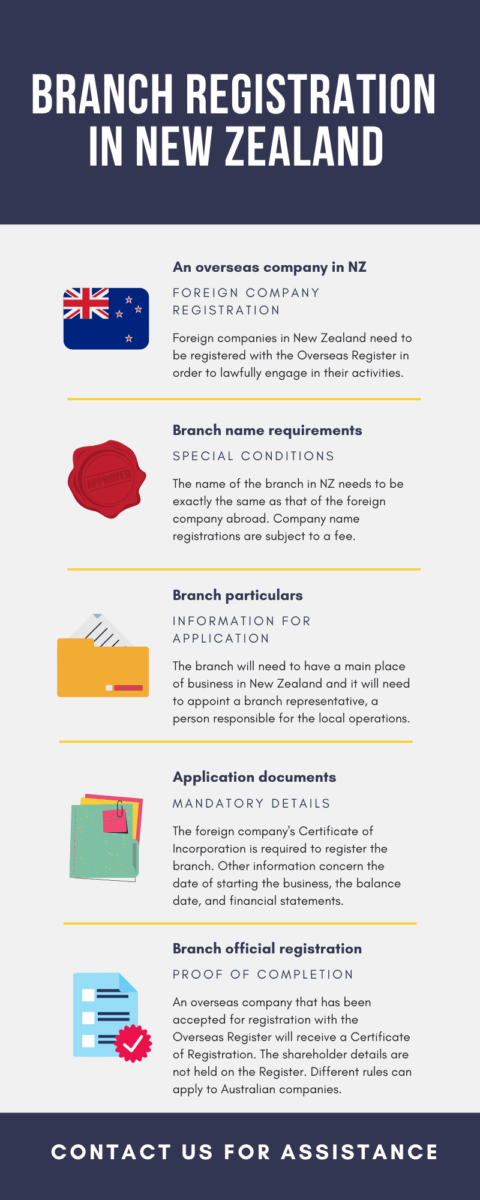
The steps needed to open a branch office in New Zealand
Foreign businesses that set up their activities in New Zealand in 2024 need to follow four main steps. The registration must take place within 10 days from the branch’s first day of activity in the country.
Australian companies that do business in New Zealand via a branch office are also required to register.
Below, our New Zealand company formation agents highlight the four important steps:
- Reserve the company name: this is important because the branch needs to have exactly the same name as the one it uses in the country in which it is originally incorporated.
- Prepare the documents for registration: these include the registered address that will be used for the branch in NZ, the appointed authorized person, the date on which the branch started business, the parent company’s Certificate of Incorporation as well as the director’s details;
- Submit the application: this is the formal application for a NZ branch registration and it can be performed once the approval for the name reservation is received;
- Receive the confirmation: once the application for registration is processed, the branch receives the Certificate of Registration and it will be included in the Overseas Register.
As far as the director’s details are concerned, these include the full legal name and the residential address, as well as the e-mail address and the telephone number(s).
Unlike in the case of the director of a branch office in New Zealand, the Overseas Register does not require, not keep shareholder details.
All documents that are not in English (for example, for companies incorporated in non-English speaking countries) need to be accompanied by a certified translation into English.
Australian companies have the option to enter their Australian Company Number and retrieve the name from the Australian Securities and Investments Commission register.
This allows the company to make sure that the business name reserved in New Zealand for the branch is the same as that of its Australian parent company.
We invite you to watch a video about branch registration:
Some of the rules concerning company names in New Zealand include the following
- the name cannot be reserved if it is identical or almost identical to the one of an already registered company;
- the difference can be as little as one of the names having the letter “s” added to the end because it is plural;
- as previously stated, the name of an overseas company in New Zealand needs to be identical to the one used to register the business in its country of origin;
- if the founders wish to change the name of an overseas company in NZ, they will need to make sure that the new name is available for registration in both jurisdictions; the name is first changed in the foreign country and then in New Zealand, following the receipt of an official confirmation for the name change abroad;
- some names are protected by law in New Zealand; these include: Interpol, minister, parliament, royal, ruyakura, bank or insurance unless it is involved in these activities; other name restrictions or protections are also in place;
- if the name reservation is rejected, the applicant is expected to fill in a new reservation and pay the additional fee once more.
Some of the costs associated with opening and managing a branch in New Zealand include:
- $10 for the name reservation (plus GST);
- $130 for the online NZ branch registration (to which GST is added);
- $49.74 plus GST to file the annual return;
- 28% is the tax rate for businesses in New Zealand, also applicable to branches.
Please note that the fees mentioned above can be subject to change.
In 2024, the goods and services tax (GST), the New Zealand equivalent of the value-added tax maintains a standard rate of 15% and a reduced rate of 0%.
This tax applies to various types of goods and services, among which intangibles are also included (for example, digital downloads that are supplied remotely by an offshore provider). The GST also applies to the supply of distantly taxable goods.
Our team can give you more details about this tax and how it applies in the case of NZ branches.
Financial reporting and obligations for overseas companies in New Zealand
Upon registration, a NZ branch is required to provide essential financial information. The month in which the annual return will be filed can be chosen when the registration is made, however, it cannot be December or January. Moreover, a date for submitting the balance for the company will also be chosen on registration. For branches, it is useful to remember that they must have the same balance data as the rest of the company.
Large overseas companies that set up their operations in New Zealand are required to submit an annual audited financial statement with the Companies Register. More on this requirement can be provided upon request by our team of New Zealand company formation agents. Additionally, the New Zealand counterpart of a large overseas company will need to include the parent company’s financial statements when it submits its NZ financial statements.
Below, our team also lists other obligations for branch offices in NZ. If you need more details, please feel free to reach out to us for more details.
Obligations of branch offices in New Zealand
As a satellite of the foreign company, the New Zealand branch office is required to submit the following information with the Companies Register:
- information about the parent company – the address in the home country and its incorporation documents;
- annual accounting documents- financial statements of both branch and parent company;
- information about a representative of the parent company in New Zealand;
- an e-mail address through which the parent company can be contacted by the authorities.
Branch offices can operate in various industries in New Zealand based on specific licenses.
Overseas companies in New Zealand
As seen above, the branch is one way in which a foreign company can do business in New Zealand.
The three recognized ways in which a foreign company can operate here are the following:
- as a New Zealand subsidiary: when the overseas company incorporates a New Zealand company (registered in the Companies Register) and it owns 100% of its shares;
- as a branch: when the foreign company registers as an overseas company, not as a separate legal entity but governed by NZ laws;
- when it is transferred to New Zealand: the foreign company renounces its country of origin, that in which it was initially registered and it transfers its registration to New Zealand completely (by following the same steps for registering with the Companies Register).
The choice between these three options depends on the foreign company’s business plan, the level of desired control of the overseas company (such as in the case of the subsidiary), as well as other issues that may be relevant to the particular business field in which it will activate.
When the company is transferred to New Zealand, it will need to have at least one director who lives in New Zealand or in Australia and he is also the director of a company incorporated in Australia.
When the subsidiary is incorporated in New Zealand, or a foreign company is transferred to the country, there is the option to incorporate with or without a company constitution, the first method being preferred in certain cases.
The company’s constitution sets forth the rights and duties of the legal entity, as well as those of the board, the director(s), and shareholders.
The constitution can be a standard one, or it can be prepared with the help of our New Zealand company formation experts.
The company in New Zealand incorporated as a separate legal entity to serve as the subsidiary of an overseas company will need to have a local company address, a new and original registered company name, as well as register the appointment of its director and shareholder.
Our team can give you more details on the requirements for branch and subsidiary creation, as well as provide you with other information such as essential data on taxation and reporting, among others.
Creating a fixed place of business in New Zealand is an important decision for the expansion of a business. It involves not only the steps needed to start a business in New Zealand, but also matters concerning staff employment, appointing a local agent, and understanding the taxation of the branch in NZ. Our team can answer all of these questions and more when you set up a branch.
NZ company statistics
Below, our team presents a set of key facts concerning business demography in New Zealand. The provisional data for February 2023 from the National Statistical Office shows that:
- There were a total of 605,000 companies in New Zealand, a 1.8% increase compared to February 2022;
- The companies had a total of 641,560 business locations, an increase of 1.7% compared to February 2022;
- Out of 19 key industries analyzed for the statistics, in 17 of these, there were more incorporated businesses compared to the previous year;
- At a regional level, all the country’s 16 regions had more business locations compared to February 2022;
- The number of paid employees working in these companies was also higher compared to a year prior, at 2.5 million (estimated, not an official statistic).
For assistance in opening a branch office in New Zealand, please contact us. We assist all foreign nationals who plan on registering an Australian company, or registering an overseas company (a company that is not Australian) in 2024.
You can also rely on us for other company formation services in New Zealand.